From my studio
Why I begin with big shapes
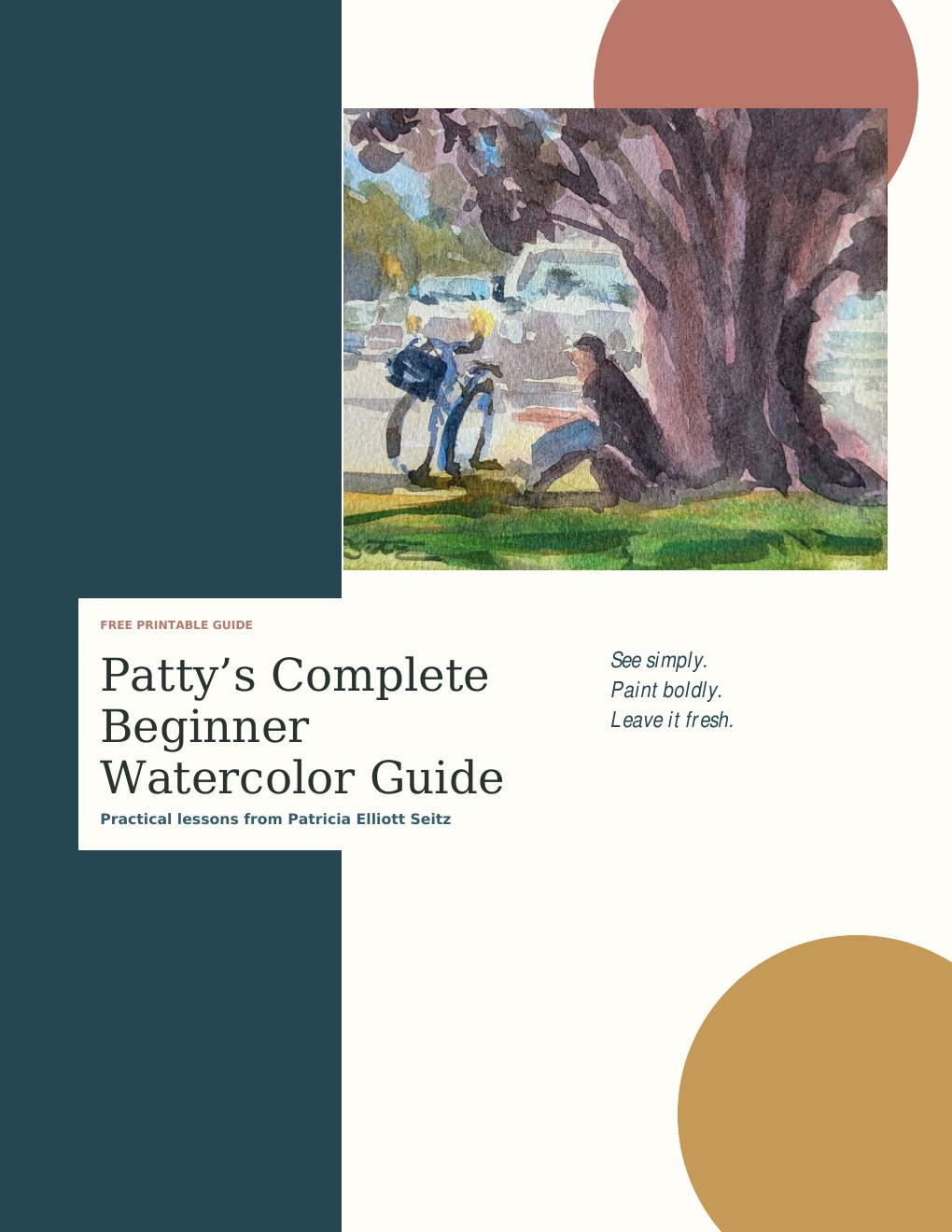
The little windows, branches, and buttons can wait. A painting first needs a strong arrangement of light and dark that reads from across the room.
Watercolor lessons from Patricia Elliott Seitz
Friendly, honest guidance for beginners who want to understand the medium—one small, useful exercise at a time.
“Big shapes. Lost edges.
Light doing the storytelling.
Your first lesson
Before choosing pigments, reduce your reference to three clear values. This makes complicated scenes feel manageable and gives every later wash a job to do.
Look for the largest light and dark families, not objects.
Join similar values into broad, simple shapes.
Use it sparingly to lead the eye to your focal point.
Free 18-page printable ebook
Keep my essential beginner lessons beside your painting table: materials, palette setup, brush handling, water timing, clean washes, values, composition, edges, shadows, troubleshooting, and a two-week practice plan.
A quick look at my process
Loose watercolor does not mean careless watercolor. Watch how a few direct marks, simple shapes, and transparent washes can capture the feeling of a place without explaining every detail.
This short studio glimpse is a taste of the step-by-step demonstrations coming to the lesson library.
Visit my YouTube channel ↗Beginner guide library
Values
See how I reduced a busy ice-cream stand to white paper, one middle value, and one connected dark.
Values
Follow one busy street scene from my reference photograph, through a three-value plan, and into the finished watercolor.
Values
Learn how I carry the light, middle, and dark families from my value study into color without copying every mark.
Values
Compare my original value study with teaching notes placed directly over the same painting, then see how one stronger dark mass clarifies the focal figure.
Color
See two separate paintings: a Payne’s Gray value study used to plan the shapes, followed by a full-color watercolor on a new sheet.
Animals
Watch five short demonstrations as I simplify a white hen, a mallard duck, a busy farmyard, a calf, and a grazing horse into gesture, saved lights, connected shapes, and useful darks.
Composition
See how I cropped an ordinary street photograph, removed distractions, and used connected shadows to make the sunlight feel stronger.
Brushwork
See how simple planning, larger connected shapes, varied edges, and a clear stopping point help me keep a painting alive.
Practice
Use seven practical questions to decide whether your watercolor truly needs another mark—or whether it is time to put the brush down.
Brushwork
Learn how grip, angle, pressure, the side of a round brush, and paper timing change the mark you make.
Supplies
See how I pair a homemade mint-tin palette with a roomy John Pike palette to keep my colors close and prepare plenty of wash.
Practice
Build confidence with one purposeful 10–20 minute study on good cotton paper—and stop while you still want to paint again.
Color
Watch me charge richer color into a glossy wash, then compare the movement with the completely dry result.
Water
Compare my real-time demonstrations, see the graduated wash completely dry, and learn when to maintain one mixture or gradually dilute it.
Water
Recognize wet, damp, and dry paper before the brush touches down.
Edges
Use edge variety to keep the focal point clear and the rest of the painting breathing.
Color
Practice warm and cool mixtures with fewer colors so your washes stay fresh.
Brushwork
Paint a subject as one clear silhouette instead of many small marks.
Supplies
See the professional cotton papers and artist-quality tube paints I trust, plus a realistic way for beginners to spend wisely and start small.
Figures
Use posture, connected values, cast shadows, and a few useful accents to paint convincing people without fussy detail.
Notes from my studio
Short reflections on practice, patience, and learning to see.
From my studio
The little windows, branches, and buttons can wait. A painting first needs a strong arrangement of light and dark that reads from across the room.
A watercolor reminder
Watercolor often becomes tired when we keep correcting it. A second small attempt can teach us more than another twenty minutes of fussing.
Behind the painting
A quiet Syracuse street, winter light on an old building, or a figure crossing the road can hold everything a painting needs.
Personal guidance
Email me a clear photograph of one watercolor painting and tell me where you feel uncertain. Keep the original painting safely with you—I only need the digital picture.
Design and drawing
Subject choice, composition, values, focal point, and what could be simplified.
Watercolor handling
Color, washes, edges, brushwork, and where to strengthen, soften, connect, or leave alone.
Strengths and practical next steps
What is already working, what to practice, and a clear action plan for your next painting.
Photograph only—please do not mail your original painting.
After checkout, email a clear digital photograph of your painting—and your reference photo, if you used one—to patriciaseitzgallery@gmail.com. The PayPal page accepts payment only; your pictures come to me separately by email.
Before you book
I want you to know exactly what to expect. My critique is personal, encouraging, and focused on helping you make clearer choices in this painting—and the next one.
Honest guidance, gentle encouragement, and practical next steps—from one artist to another.
You’ll receive a personal written critique by email. I’ll consider your subject choice, composition, drawing, values, color, focal point, washes, edges, and brushwork. I’ll explain what is already working, what could be stronger, and give you a practical action plan for your next painting.
No—please keep your original painting safely with you. I need only a clear digital photograph of it, sent to me by email after checkout. PayPal processes your payment but does not collect your pictures; there is no painting-upload portal.
Email one clear, well-lit digital photograph of your watercolor painting—never the physical original. Please include your name, PayPal order number, the reference photo if you used one, what you hoped to achieve, and what you would most like help with. If I can’t see the painting clearly, I’ll ask for another photograph before I begin.
If you know them, you may also tell me the painting’s size, the watercolor paper you used, whether you painted from a photograph, imagination, or outdoors, and approximately how long you worked on it. These details are helpful but optional—please don’t let them keep you from booking a critique.
Please allow up to seven days after I receive your painting, reference, and question. I’ll confirm that everything arrived; if I ever need a little longer, I’ll let you know.
I accept only three critique purchases each week so every painting receives thoughtful, personal attention. When those spaces are filled, booking temporarily closes. New spaces are added only after the current critiques are completed.
Each $39 critique covers one watercolor painting. Keeping the focus on one piece lets me give it the thoughtful attention it deserves. A second painting requires a separate critique purchase.
This is an educational critique, not a repainting or paint-over service, formal appraisal, competition judging, or a guarantee of an award, acceptance, or sale. I’ll give you clear suggestions, but the artistic decisions always remain yours.
Yes. Your painting and reference are used only to prepare your critique. I will never post or share them publicly without asking for your clear permission first.
Contact me as soon as possible. If I haven’t begun your critique, I can cancel and refund the purchase. Once I’ve started the critique or delivered the feedback, the fee is nonrefundable. If I’m unable to provide the service, you’ll receive a full refund.
Always. I’ll be honest, but never harsh. The goal is to help you see what is working, understand what could be simplified, and leave with a practical next step—not to make you afraid of your brush.
Meet your guide
I’m Patricia Elliott Seitz, a professional watercolor artist in Liverpool, New York. I paint Central New York’s historic buildings, quiet streets, changing seasons, and everyday stories with transparent watercolor and expressive brushwork.
Watercolor is beautiful, surprising, and sometimes stubborn. I believe beginners deserve clear foundations, encouraging practice, and permission to learn in baby steps.
A quieter kind of community
Have a watercolor question? Send it to me privately. Selected questions may inspire future lessons, helping everyone learn—without public accounts, comments, or noise.
Ask me a watercolor question ↗