Begin with the silhouette
Look for the tilt of the head, shoulders, torso, and legs. Posture communicates more than facial features.
Figure lesson · Simplification, values, and small paintings
You do not need to paint every facial feature, finger, fold, or strand of hair. A believable posture, a clear value shape, and one or two useful accents are often enough to make a person feel alive.
The reassuring truth
From my studio
“If the posture and values are right, the figure can read without a painted face.”
Step back from the painting. If you can understand who is standing, walking, or working, the figure is already doing its job.
Keep it simple
Look for the tilt of the head, shoulders, torso, and legs. Posture communicates more than facial features.
Reduce clothing, skin, and shadows to light, middle, and dark shapes instead of naming every separate object.
Nearby people can share edges and dark shapes. They do not need a hard outline around every arm and leg.
A hat, safety vest, warm shirt, or small hand shape can tell the story. Stop before description becomes fussing.
Studio demonstration
In this short demonstration, I build the scene with loose, connected shapes instead of outlining every person. Watch how the figures stay simple while the darker foliage and cast shadows give them a place to stand.
Music-only demonstration · 3 minutes, 47 seconds · Music and lyrics by Pseitzartist
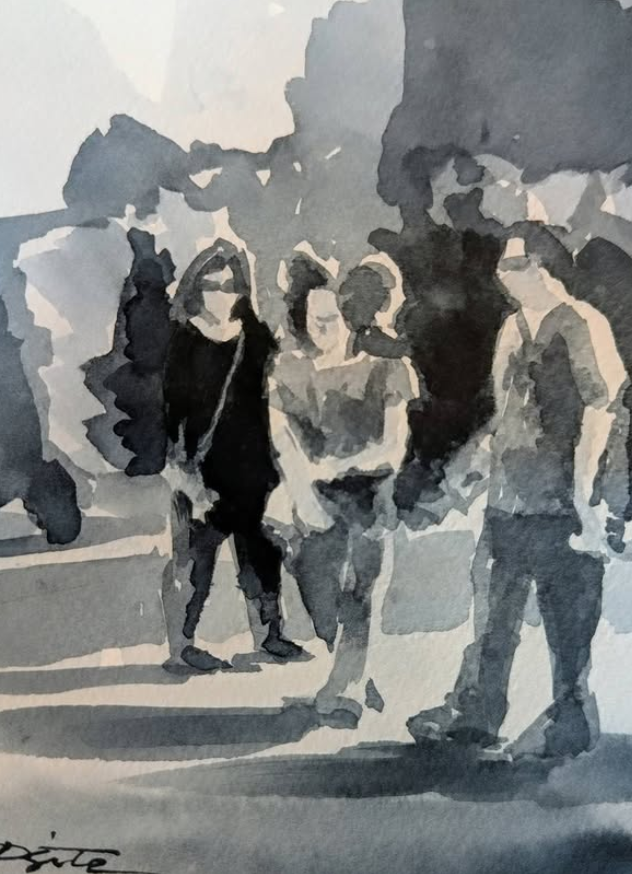
Start with values
The central face is mostly light paper, yet the woman reads clearly because the head, hair, clothing, posture, and surrounding values are in the right places. The group is organized as connected light, middle, and dark families—not as a collection of separately outlined people.
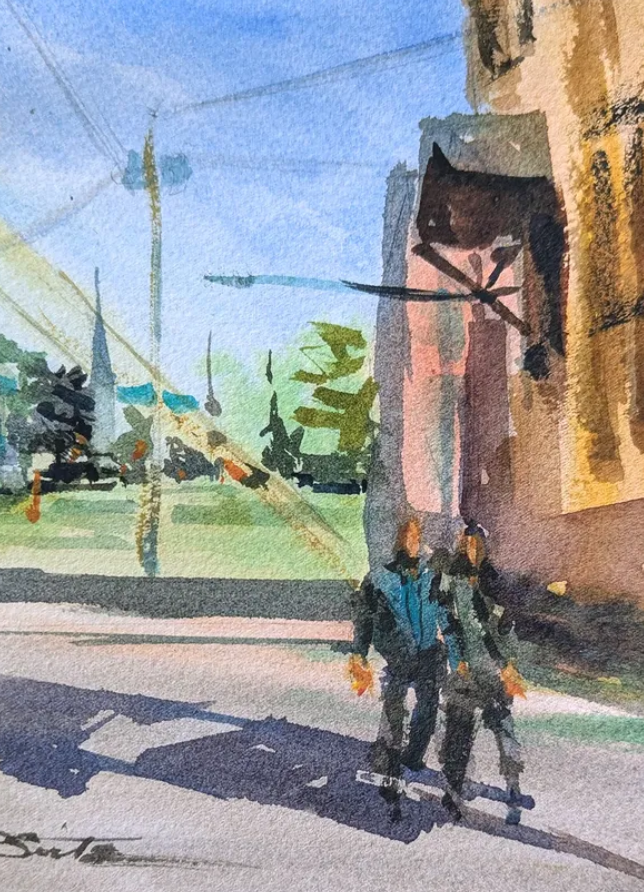
Connect the group
The figures share darks, but differences in height, stride, arm position, and small color notes keep them readable as two people. Their long cast shadow establishes the direction and strength of the sunlight more powerfully than facial detail ever could.
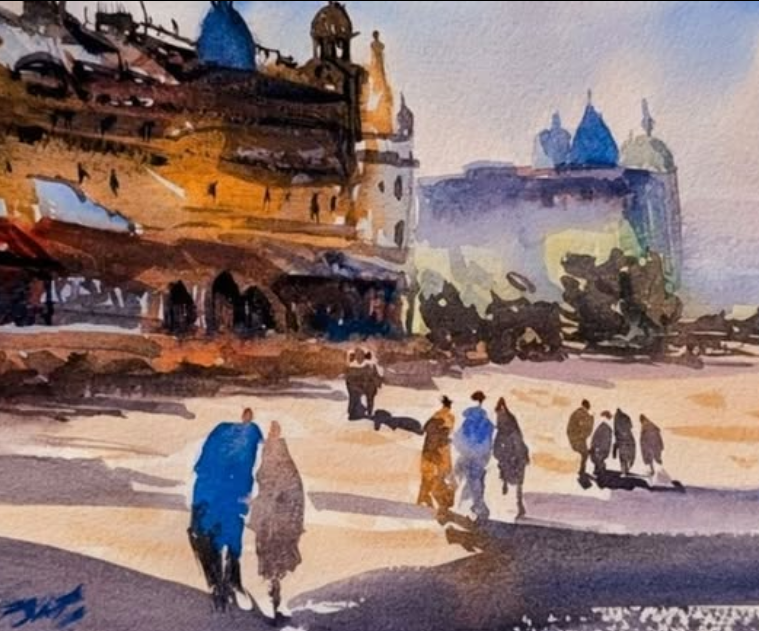
Create depth
The nearest pair receives larger shapes and stronger color. The middle groups are smaller and simpler, while the farthest people are little more than upright marks. Their changing scale and placement carry the eye into the scene—no detailed faces are needed.
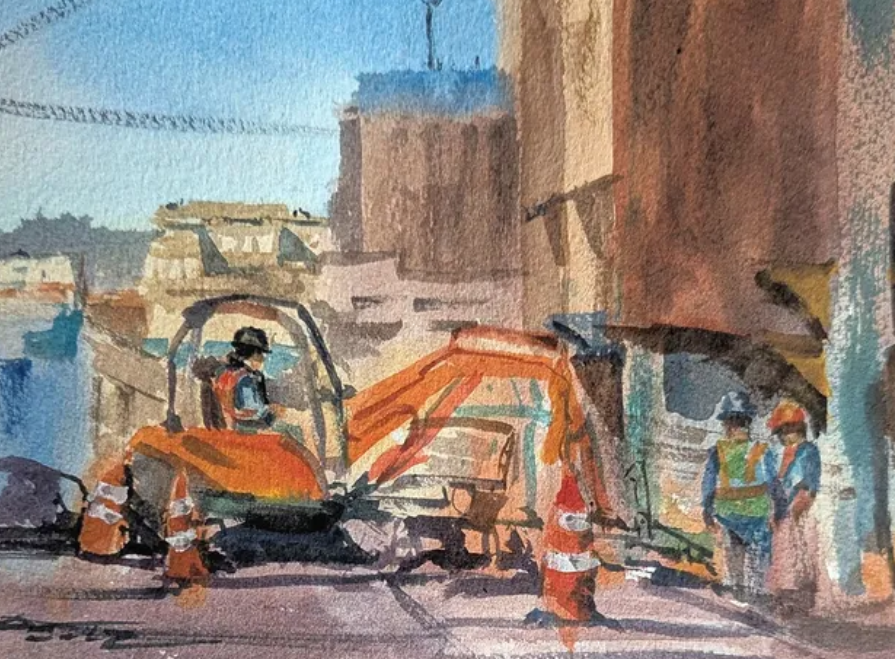
Tell us what they are doing
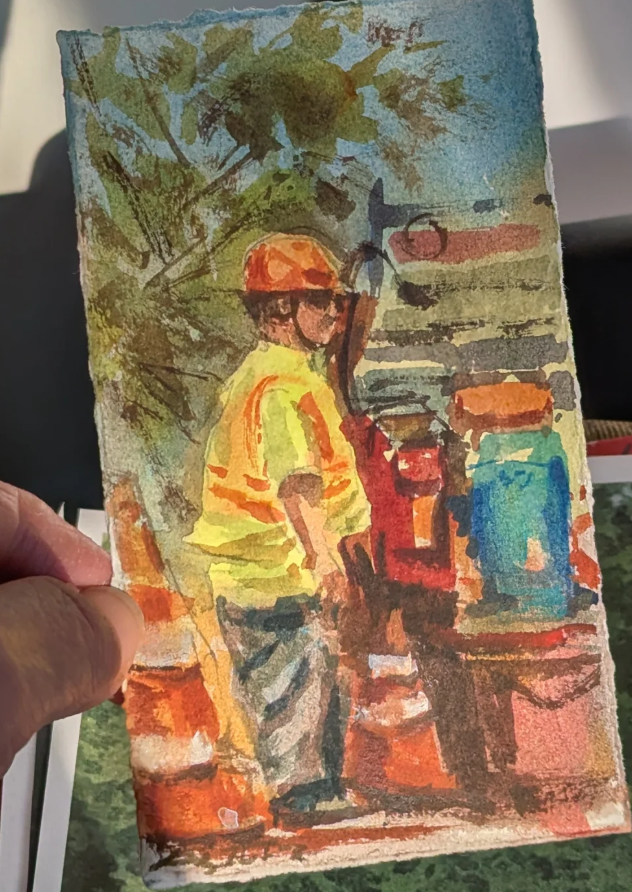
Small notes of safety orange, blue, and yellow immediately identify the workers and their activity. The people belong to the larger shapes of the machinery and buildings, so they feel integrated into the scene instead of pasted on top of it.
Paint small
The warm yellow shirt creates a clear focal figure, while the smaller blue figure adds depth and activity. The photograph of the painting in my hand shows just how small it is—and how much light, color, and story can still fit inside it.
Let the main idea lead
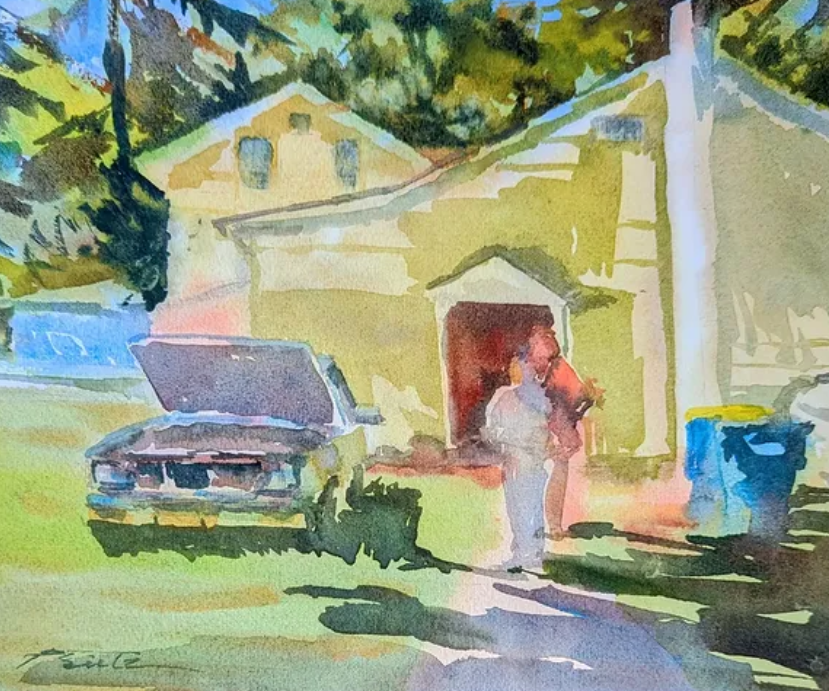
Here I was conveying the light that day and the bright blue sky. The warm sunlit building, cool cast shadows, and small figure work together. The person adds life and scale without competing with the painting’s true story.
Small paintings, complete ideas
“A painting does not have to be enormous to be well executed.”
Small paintings can be beautiful, complete, and thoughtfully designed. Working at a modest size can help an artist concentrate on movement, light, value, and the placement of shapes. Large paintings can certainly be beautiful, but they require careful planning. Sometimes an artist tackles more space than the idea can comfortably support, and the result becomes awkward, static, or overworked.
Choose a size that serves the painting—not one intended merely to impress.Your turn
Use good cotton paper, one color, and about ten minutes. This is practice—not a performance.
Choose a reference with one or two clearly posed people.
Draw only the head, torso, and direction of the legs.
Place one broad middle value and one connected dark.
Add the cast shadow so the figure stands on the ground.
Add one useful accent, then leave it alone.
Remember