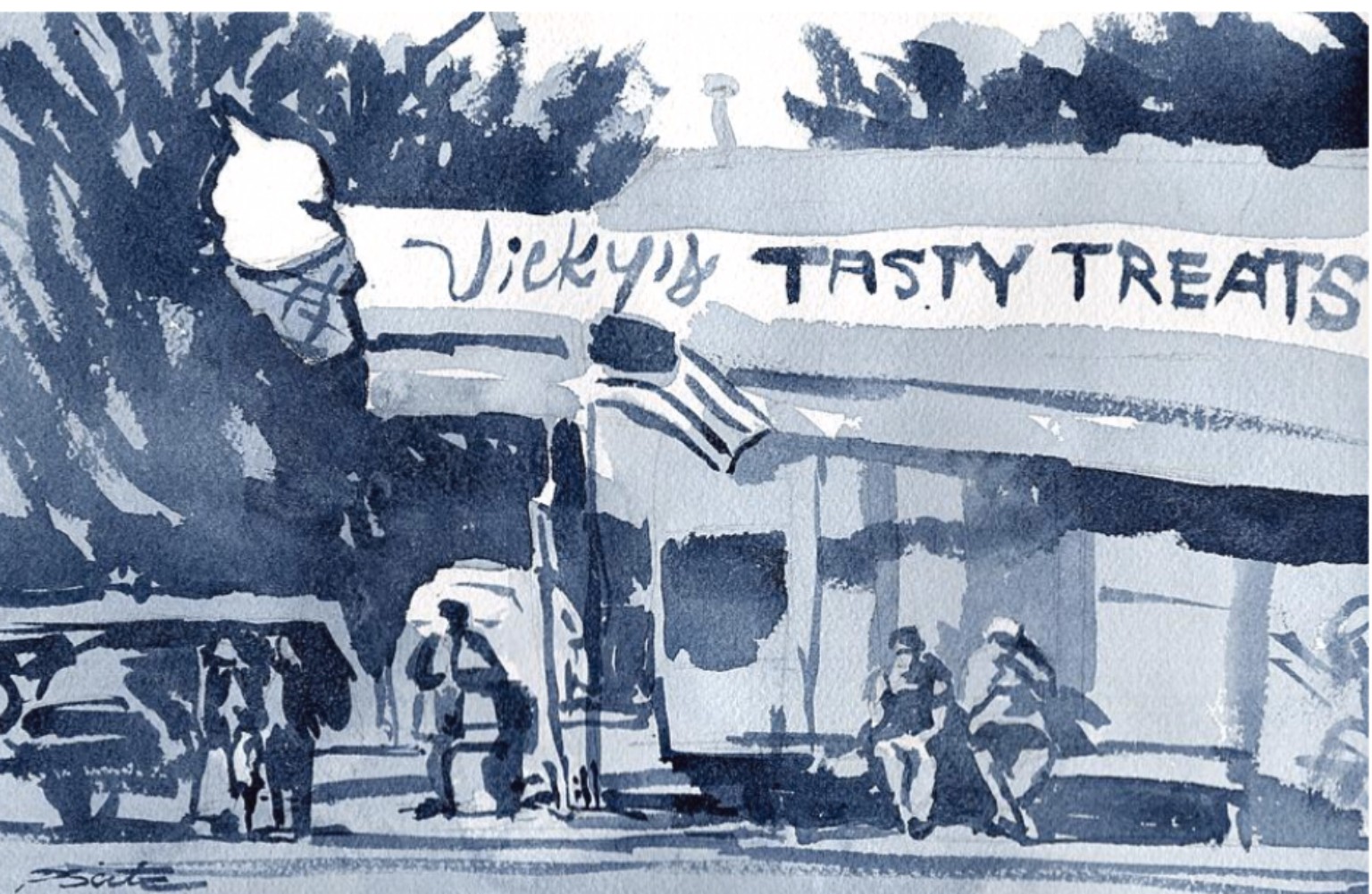
Vicky’s Tasty TreatsOriginal three-value watercolor study by Patricia Elliott Seitz.
White paper · middle value · darkThe important shift
See connected shapes—not separate objects.
From my studio
“Composition first. Decide what to leave out, then make the value pattern clear.”
The trees, people, vehicles, signs, and building do not each need their own treatment. They can be joined into a few large value families.
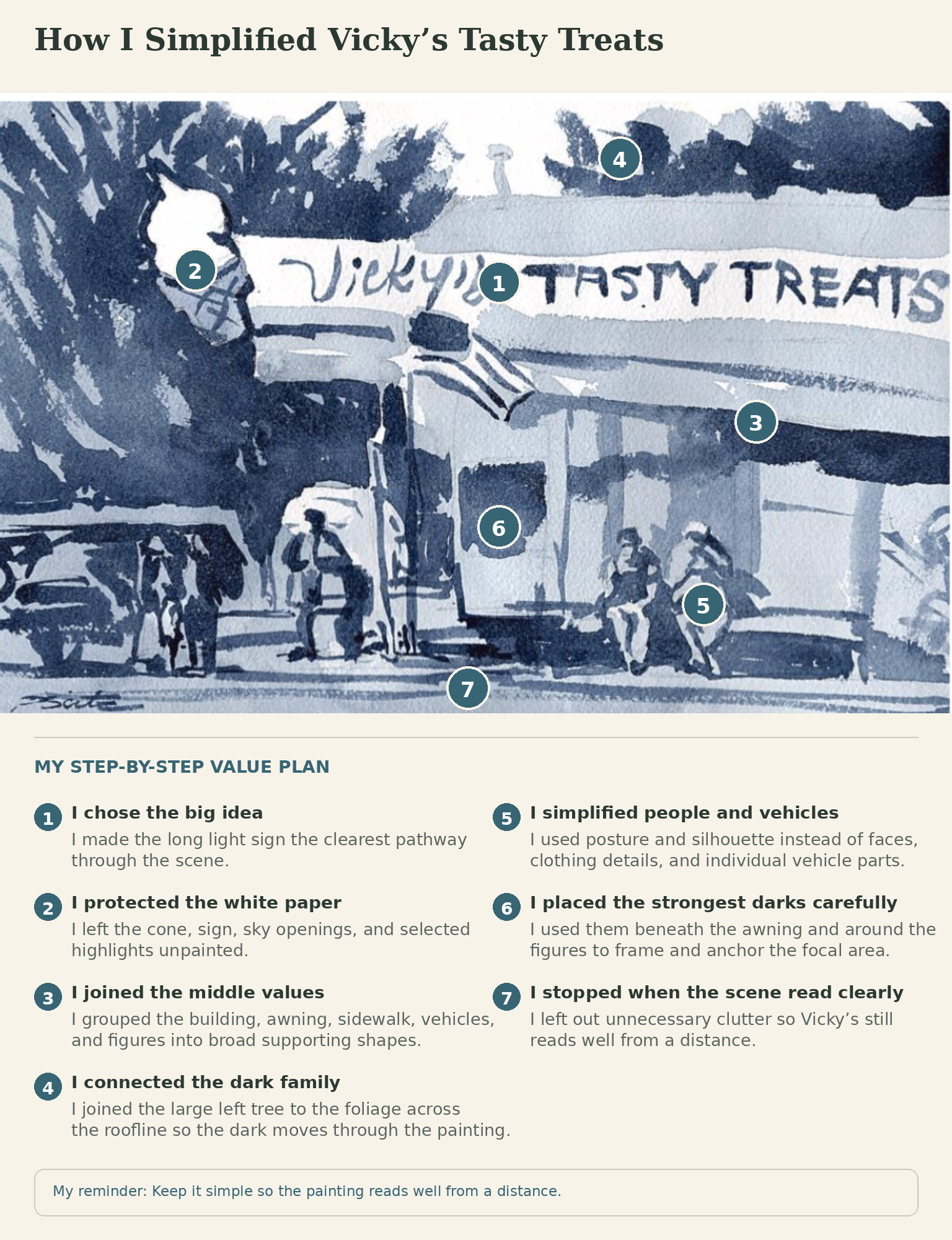
1
White paper
The light family
- The ice-cream cone and long sign
- Open sky shapes above the roof
- Selected clothing and figure highlights
- Broken light across the sidewalk
What it does: The white sign becomes the painting’s clearest pathway and immediately identifies the subject.
2
One middle value
The supporting family
- The awning and broad building walls
- Large portions of the vehicles
- The sidewalk and foreground bands
- Selected shapes within the people
What it does: The middle value connects the separate pieces without competing with the focal sign and figures.
3
Connected dark
The anchoring family
- The large tree mass on the left
- The foliage running across the roofline
- The deep horizontal storefront band
- Chosen figures, windows, and car accents
What it does: The dark shapes frame the shop, ground the people, and move the eye across the full composition.
The brave part
What I simplified.
01Individual leavesThe trees become bold, interlocking silhouettes.
02Facial detailsPosture and value are enough to make the figures feel alive.
03Vehicle detailsWindows, tires, and bodies are combined into readable blocks.
04Small building clutterOnly the major roof, sign, awning, and window divisions remain.
Your turn
Build a three-value study
Choose a busy local scene and work small. Use Payne’s Grey or another single dark pigment so color cannot distract you from the design.
- Step 1
Protect the white pathMark the lightest connected areas before applying a wash.
- Step 2
Join the middle shapesPaint broadly across unimportant boundaries instead of circling every object.
- Step 3
Connect the darkest darksUse them to frame the focal point and anchor the people to their surroundings.